

Reviewed · KIBERA SLUM TOURS
Kevins Kibera Slum Tours
Kibera is not a backdrop for sightseeing. It is a living neighborhood, and this private tour takes you through it with guides who grew up there. Kevin and his brother Ismael bring you to a school, a family home, a bone workshop, the market, the train track, and other places that show how people work, study, and live.
I like the local connection and the chance to meet Kevin’s family at home. I also like that the tour includes community projects, such as a school for children and small workshops, instead of reducing Kibera to scenes of poverty. The main drawback is the walking: paths can be rough, muddy, narrow, and difficult after rain.
Key points at a glance
- Local guides Kevin and Ismael: You explore with men raised in Kibera who can explain the area through personal experience.
- A private four-hour visit: Your group travels together rather than joining a large public crowd.
- Family homes and schools: The visit can include Kevin’s house, his family, and an orphanage school.
- Hands-on local work: You may see a cow-bone workshop, a community bag-making project, and the main marketplace.
- Hotel pickup and drop-off: Transport from your Nairobi hotel is included, though you should confirm the pickup time.
- Good walking shoes are essential: Wear closed-toe shoes that can get very dirty, and think twice if you have balance or mobility problems.
Entering Kibera with a guide who grew up there
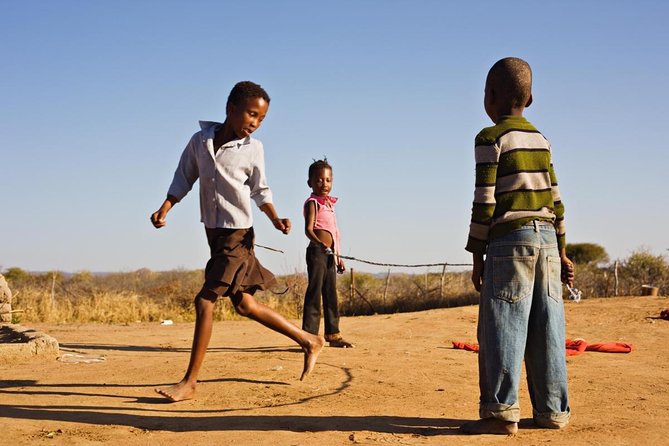
Kibera is often described as Africa’s largest urban informal settlement. That label gives you scale, but not much sense of daily life. This tour fills in the human details through a local guide who knows the lanes, families, schools, workshops, and community groups.
You may be guided by Kevin or by his brother, Ismael, also spelled Ishmael in some accounts. Both are described as having grown up in Kibera, and Ismael still lives there. That matters because you are not simply following a guide who memorized a few facts. You are hearing personal stories and meeting people who know the guide by name.
The private format also helps. Only your group takes part, so you can ask direct questions and move at a pace that suits your party. A solo visitor, couple, or family with older children may find this more comfortable than a large group tour.
The tour lasts about four hours, with roughly three hours spent at the Kibera stop itself. Pickup begins at 8:00 am from hotel accommodation in Nairobi. Since one visitor reported a pickup an hour later than expected, I would confirm the meeting time clearly before the morning of the tour and allow some flexibility.
More guided Kibera walks:
- Nairobi: Explore Kibera Slum with Local Guides
★ 4.9 · 365 reviews - Nairobi: Kibera Slum storytelling tour with a Local
★ 5.0 · 185 reviews - Kibera Slum Tour with Lucas
★ 5.0 · 119 reviews
The school visit shows more than hardship
One of the most affecting stops is a local school and orphanage. The visit gives you a look at children studying in difficult conditions and at local efforts to support them.
The school is not presented as a polished tourist attraction. It is part of the community, and the purpose of the stop is to show how education works where funds and facilities are limited. You may hear about efforts to help promising children continue their studies, including support for boarding school.
This is where the tour can shift from simple observation to a more useful understanding of Kibera. You see the problems, but you also see people trying to solve them. Small schools, local staff, and community projects offer some hope in a place where public services can be limited.
You should approach this stop with care. Children are not scenery, and the visit calls for respectful behavior. Follow your guide’s lead about photographs, conversation, and where you should stand. The best part of the stop is listening and learning, not collecting dramatic pictures.
Families with children of their own may find this part especially meaningful. The tour is not described as restricted by age, and most people can participate, but parents should decide if their children are ready for difficult scenes and a serious conversation about poverty.
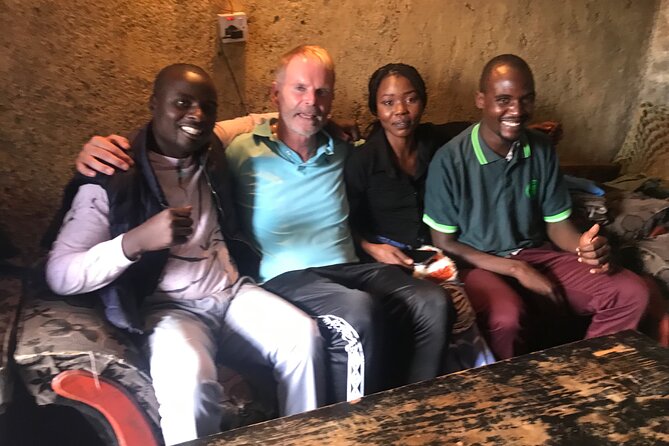
A family home makes the visit personal

Kevin’s house and family are among the most unusual parts of the experience. Ismael may also welcome you into his own home and introduce you to relatives. This changes the tone of the visit.
A home visit can show you ordinary family life in a way that a walk through public streets cannot. You may see where a family gathers, hear stories about growing up in Kibera, and understand that the neighborhood is not only a place of hardship. It is also home.
The visit has real value because it places daily life beside the larger social issues. You may see poor infrastructure and unsafe paths, then sit with a family that laughs, jokes, and talks together like families anywhere. That contrast is more useful than a simple before-and-after story about poverty.
Still, remember that you are entering someone’s personal space. Be polite, ask before taking photographs, and do not treat the home as an exhibit. A small, respectful group is better suited to this stop than an intrusive crowd, which is another reason the private format works well.
Workshops reveal the work behind everyday survival
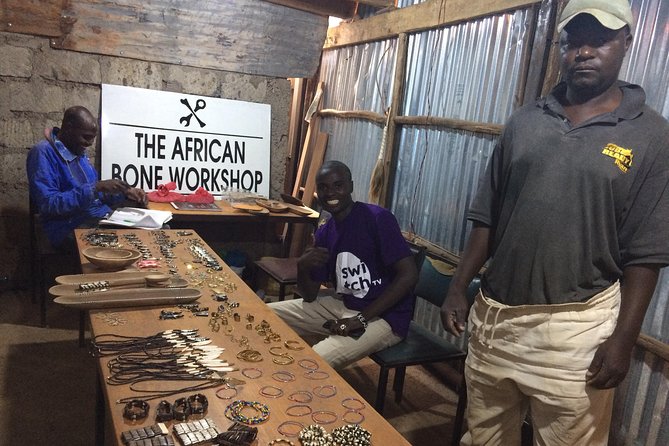
The itinerary includes an African bone workshop, sometimes described as a cow-bone jewelry-making factory. Here you can see how discarded animal bone becomes useful or saleable craftwork.
This stop adds a practical layer to the tour. You are not only looking at housing and roads. You are seeing skill, work, and enterprise. A workshop like this helps explain how people create income with limited materials and space.
Some accounts also describe a community empowerment bag-making company. The exact stops may depend on the day and the guide, but the larger point remains: Kibera includes people working to build livelihoods, not simply waiting for help.
I find these stops important because they resist the easy image of a community defined only by need. At the same time, you should not expect a formal factory tour or a guaranteed shopping experience. The listed route names the bone workshop, while the bag-making project appears in detailed accounts of the visit. Ask your guide what is possible on your date.
A few more Nairobi trips worth comparing
- Nairobi National Park Half-Day Tour; Free Wi-Fi connection
★ 5.0 · 878 reviews - Nairobi: National Park & Optional Elephants & Giraffe Center
★ 4.8 · 874 reviews - NAI NAMI: Nairobi Storytelling Tour with Street Children
★ 5.0 · 792 reviews - Nairobi National Park Half-Day Game Drive
★ 4.5 · 738 reviews
The landfill and train track show the hard edges
The landfill and train track are among the more difficult parts of the route. They help you understand the physical setting and the hazards residents face, but they can also feel stark and uncomfortable.
The walking conditions are a serious matter. Paths may be narrow, uneven, muddy, or precarious, especially if it has rained. Some sections require balance and careful footing. You should wear closed-toe shoes with a firm sole, and choose a pair you do not mind getting very dirty.
If you have balance problems, trouble walking on uneven ground, or limited mobility, this is probably not the right excursion. The tour description says most people can participate, but that should not be read as a promise of easy access. This is a walking visit through an informal settlement, not a paved museum route.
The train track also reminds you that Kibera is a working neighborhood with real transport and safety concerns. Stay close to your guide and follow instructions. The fact that Kevin and Ismael are known in the community can help you feel more at ease, but it does not remove the need for care.
The market and main street bring daily life into view

The main street market gives the tour a more social and active rhythm. You may see people shopping, selling, moving through the neighborhood, and handling ordinary tasks.
This is an important balance to the heavier stops. Kibera is not frozen in misery. People shop, work, talk, study, and raise families. The market helps you see the place as a neighborhood rather than as a problem viewed from outside.
You should remain aware of personal space. Ask before photographing sellers or residents, and let your guide handle introductions. Children may be curious about visitors, but that does not mean every child wants a camera pointed at them.
The route is best understood as a walk through selected community landmarks, not a complete survey of Kibera. Three hours cannot explain every part of such a large settlement. What it can do is give you several connected views: home, school, work, public space, and infrastructure.
What $65 buys you in Nairobi

At $65 per person, this is not the cheapest way to spend a morning in Nairobi. The value comes from the private guide, hotel pickup and drop-off, and access to places that would be hard to visit respectfully on your own.
You are paying for local knowledge, time, and a personal introduction to the community. The family visit is especially difficult to arrange independently, and the same is true of the school, workshop, and other stops. A knowledgeable guide would be useful here, but the more important quality is local trust and personal connection.
The tour is also easier to plan because transport is included. You do not need to work out how to reach Kibera on your own or worry about finding the correct entrance. For a first visit to Nairobi, that simplicity has real value.
Still, the price does not include food or drinks. It also does not guarantee every extra stop described in detailed accounts, such as the bag-making project. Think of the payment as covering the private guided visit and transfers, not a shopping tour or a donation package.
If you want a polished sightseeing product with comfortable roads, air-conditioned stops, and a light mood, spend your money elsewhere. If you want direct contact with a local guide and are willing to accept discomfort, $65 is a reasonable price for a focused half-day.
Safety, respect, and the right attitude
The strongest part of the experience is the relationship between guide and community. Visitors describe feeling safe with Ismael and note that he is respected in the area. That can make a major difference when you are walking through unfamiliar streets.
Safety is never a reason to switch off your judgment. Keep your group together, listen to the guide, and do not wander away for photographs. The uneven ground is a more obvious physical risk than anything else described about the tour.
Respect matters just as much. Do not refer to residents as if they are part of a display. Ask before taking pictures, especially at the school and inside homes. Dress in a way that is practical and modest, and remember that people are going about their daily lives.
The tour can leave you feeling hopeful, sad, frustrated, or all three at once. That is a fair response. You may see children enjoying themselves in surroundings that look dangerous to you, local people solving problems with very little money, and public needs that remain unmet. Let the experience be complicated.
Who should book this Kibera visit

I would recommend it to adults who want a serious, personal look at Nairobi beyond safari parks and city landmarks. It suits people who enjoy asking questions, listening to local stories, and accepting that travel can be uncomfortable.
Families can take part, and some families with children aged eight and nine have found it meaningful. I would speak with your children first about poverty, homes, and photography. The experience is not a casual outing designed only to entertain young children.
Solo women may appreciate the private arrangement and the guide’s local connections. The personal format can feel more reassuring than walking in an unfamiliar neighborhood without support, though normal care still applies.
I would not recommend it if you need smooth paths, easy access, or a relaxed morning with little emotional weight. Rain can make the route harder, and the walking is long enough to test your balance and stamina.
Free cancellation is available if you cancel at least 24 hours before the start time. Changes or cancellations inside that window are not accepted for a refund. The tour requires good weather, and if poor weather causes cancellation, you can choose another date or receive a full refund.
Should you book Kevin’s Kibera Slum Tours?
Book it if you want to meet Kibera through people who live there and if you can handle a rough walk and difficult subject matter. Kevin, Ismael, and the family-home visit give the experience a personal center that many sightseeing tours lack.
Before booking, be honest about your mobility, confirm the 8:00 am pickup, and bring shoes that can take mud. If you do that, the tour can become one of the most memorable parts of your Nairobi stay, not because it offers comfort, but because it gives you a more complete picture of the city and the people who call Kibera home.
FAQ
How long does Kevin’s Kibera Slum Tours experience last?
The tour lasts about four hours. Around three hours are scheduled for the Kibera visit itself, with the remaining time allowing for hotel transfers.
What time does the tour start?
The stated start time is 8:00 am.
Is hotel pickup included?
Yes. Pickup and drop-off are offered from hotel accommodation in Nairobi.
Is this a private tour?
Yes. Only your group takes part in the activity.
Who may guide the tour?
The tour may be led by Kevin or his brother Ismael, also spelled Ishmael in some accounts. They are locally raised guides connected to Kibera.
What places are included during the Kibera visit?
The route includes an African bone workshop, an orphanage school, Kevin’s house and family, a landfill, the train track, and the main street market.
Are food and drinks included?
No. Food and drinks are not included in the price.
Can I cancel for a full refund?
Yes, if you cancel at least 24 hours before the experience start time. Cancellations or changes made less than 24 hours before the start time are not refunded. If the operator cancels because of poor weather, you can choose a different date or receive a full refund.
Just added around Nairobi
- Visit kibera Slum the chocolate city★ 4.8 · 3 reviews
- Day Tour to Nairobi national park, Elephants, and Giraffe Center★ 3.5 · 8 reviews
- Explore local Market matatu ride & Make Kenyan Cuisines with a home cook★ 5.0 · 8 reviews
- Kibera Slum Tour with a Local★ 5.0 · 15 reviews
- Urban Forest Tour in Nairobi★ 5.0 · 7 reviews
- Vegans special safari★ 4.5 · 4 reviews
- Private Mini Safari Tour in Nairobi★ 5.0 · 6 reviews
- Private Kenyan Cooking Class in Nairobi with a Local★ 5.0 · 3 reviews
Kibera Slum Tours, compared.



Nairobi: Kibera Slum Tour with Local Social Entrepreneurs
Read our review →



Browse the lists this tour appears in